Read the Free Trolleyville Times Monthly for the Latest News on Prototype and Model Traction!
Showing posts with label Grand Union Intersection. Show all posts

Saturday, January 01, 2022

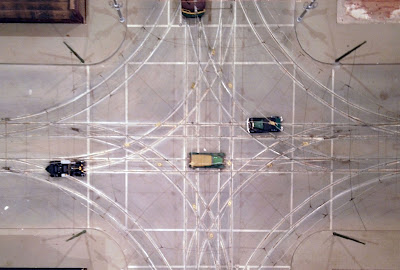
Ain't it Grand!

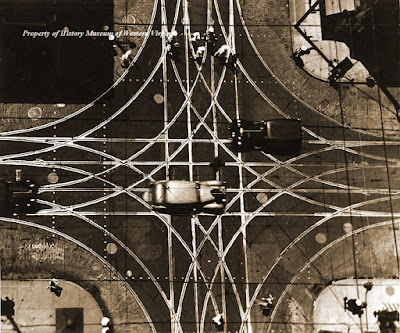
 A Great Photo of a Grand Union Intersection from Roanoke, Virginia taken in the 1930s.

Photographed in ideal conditions as well- nice new dark asphalt and the sun is just right to light up the rails.

This junction was at the intersection of Campbell Ave, and Jefferson Street in downtown Roanoke. 


What is interesting to me is how tight the intersection is. The rails of the left turn routes intersect right on the rails of the through routes. I don't think a Grand Union Junction could be any tighter.


 The overhead wire geometry is next to impossible to make out. It's easier to see its shadows. Is this four contact wires converging on one frog!?! 


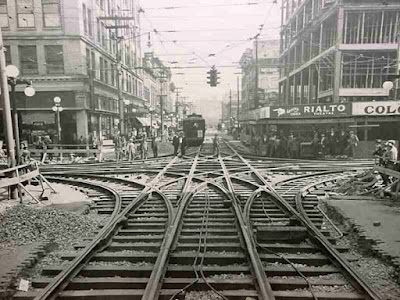
Construction Photo ca 1927.

My intersection is downright luxurious in comparison. The curves are very broad and yet still very tight for HO scale (my left turns are 7 9/16" radius or 55 scale feet). 

Anyway- I thought I would share this interesting piece of construction. Yes sir! Thought I would share!

Dandy


Monday, May 10, 2021

Street Track and Overhead Cleaning Part 2 ~ Wet vs Dry

Cleaning the Overhead with a Conductive Contact Cleaner and Keep Alive Decoders to "Track in the Dirt and Track out the Clean".

In the last post I wrote about the tools and cleaners I've tried and the ones I'm actually using. This post I'll address how I'm using them to clean the hard to reach track and overhead.

Car № 107 got its decoder before the availability of KeepAlive decoders. So if the track isn't perfectly clean its lights will flicker.

Some years ago there was a lot a debate over "Wet vs Dry" track. Some of the cleaners (like DeoxIT) conduct electricity so why not just leave the track wet with the stuff? If the track get dirty the trains will still run. While others argue that dry, shiny track is the way to go. Personally I find that starting out wet and working my way towards dry works out best for me.

Attack plan. First of all, I start with a general cleaning of the easy to reach outside loops leaving the hard to reach intersection for last. I'll run a car on a loop and address any stalls or hesitation issues until the loop is running well. Then I'll move on the to next loop until they are all running well. Then its time to attack that intersection!

As you can imagine, the intersection is the last place I want to try to retrieve a stalled streetcar. That overhead wire is like a cage. So clean track and overhead is quite desirable there. Cleaning the track through the overhead with the Double Headed Cotton Swabs is straight forward enough. But that overhead! So to clean it I developed a "trick". Let the cars themselves clean the overhead:


This is where having cars with "Keep Alive" decoders come in handy. First I'll give the capacitors in the decoders time to charge up (~20mins) while they run around the outside loops. Then I'll place a drop of DeoxIT on the contact wire just before the intersection. Then throw the turnout to route the car into the intersection. The pole will collect the DeoxIT and spread it on the wires as it goes through the intersection. The "Keep Alive" will keep the car moving through the dirty overhead until it reaches the clean track of the next loop. Each time the car traverses the intersection the trolley pole collects dirt from the contact wire and then spreads it to the clean contact wire of the outside loops. All I do is keep cleaning the track and contact wire on the easy to reach outside loops. The cars track in the dirt to the outside loops and track out the clean into the intersection. And of course, I'll clean the cars wheels and poles from time to time.

Once the track and overhead is clean enough to run my cars that don't have the "Keep Alive" decoders well I'll begin the process of drying the track. Leaving the track and wires wet with DeoxIT will just collect a thick layer of gunk and when that dries its difficult to get it off. In the photo above, the upper rail is covered with some gunk that the cars tracked in from the intersection. While the lower rail has been polished dry. That dry, polished track and overhead throughout the layout is the ultimate goal.

San Diego Electric Railway wagon outfitted for overhead wire maintenance.
So to recap:

DeoxIT on double ended cotton swabs for a general cleaning of the track and overhead as well as the poles and wheels on the cars.

Let the cars track the DeoxIT around on the rails and overhead until the layout is running smooth.

Use the double ended cotton swabs to begin the process of drying and polishing of the track, overhead, poles and wheels.

The longer the layout runs for the cleaner it gets.


I've been using that method for years. So of course as soon as I write a major blogpost about it a "new" product comes along that's highly recommended. I'm going to give this NO-OX-ID "A Special" a trial and see how it compares to my usual method. If I find significant improvement with it I'll let you know.

Yes Sir! The cleaner it gets!

Dandy

Monday, December 02, 2013

Not The First Grand Union Intersection Modeled....

...I was just the first to make a big deal about it!

There are actually a few working scale Grand Union Intersections that I know about. The first GU I saw (but I don't remember where) years ago was fully modeled but only part of it was working, the rest of the intersection was just for show. But then in the September 2010 issue of Model Railroader, a fully working O scale GU showed up:

This Grand Union Intersection is part of Les Lewis's home layout, the Connecticut Co. Notice the controls for the intersection on the lower right. As I understand it, the buttons are interlocked to prevent collisions. Press the blue button and the car will proceed straight through the intersection. Press the yellow for a right turn. Green for left turn, and press the red button to stop the car.

This is the first Grand Union that I know of that was built in HO scale:

 This nicely built Grand Union was built by Charlie "Chuck" Grant. As I understand it, it's part of his home layout but  it can be removed and connect onto the modular layout of the East Penn Traction Club.

Here is another HO scale Grand Union Intersection module recently built for a German tram club, Modular Nuremberg. The remarkable thing about this GU is that the rails are insulated for two rail operation! Here is a video that has a snippet of a tram negotiating a left turn through it at the 10:24 mark.

So, sorry my friends, I'm not the first to complete one. But they sure are fun all the same. If  you know of anymore, let me know and I'll post them here. Yes sir! Let me know!

Dandy


Monday, November 18, 2013

The Grand Union Intersection in Action!

A Video of the Fully Functional Grand Union Intersection in HO Scale!


The dang thing actually works! Yes sir! It actually works!

Dandy

Monday, November 11, 2013

Resolution Resolved!

The first day of this year (2013) I resolved to get my layout running before years end. Today I am proud to announce the fulfillment of that Resolution.


The completed intersection:


Next week I'll be posting a video of the intersection in action that I think you'll really like. You definitely won't want to miss it! Yes sir! You won't want to miss it!

Dandy

Monday, November 04, 2013

Cutting in!

Locating and Installing the Turnout Pans

The prospect of nipping the running wire so as to insert a turnout pan is a bit unsettling to me. After all, the mainline is running so beautifully that I would hate to mess it up. But if the layout is going to run as designed, well, I've got to cut in those turnouts. So before I do, I want to be perfectly certain as to where that pan should go exactly.

So I read the Trolleyville Guide to Hanging Simple Overhead very carefully first. Then with a Sharpie I marked the wire where the cut happens: 1/3 the distance between the switch point and the frog. 

In addition to the cut mark, I also marked where the holes in the pan line up with the wire so I know where to bend the wire up so as to maintain the same tension in the overhead. 
Now I have the confidence to...

Snip! Twang! Boing! Cut. Then using the marked locations as a guide I bent the ends of the wires up.

The bent wire ends are threaded up through the holes in the pan and then bent back. I soldered the joints for good electrical continuity. Cleaned it up and ran the cars through. So far so good. One Turnout Pan in, 15 to more to go.
Well that wasn't so bad, was it? Yes sir! That wasn't so bad!

Dandy


Monday, October 21, 2013

Grand Union Overhead

I've seen some Grand Union track-plans published.  But never for the overhead wires!

So the engineering dept of the Dan D. Sparks Plywood Development and Transportation Co. has its work cut out for it designing a reliable working overhead cantanary wires for this intersection.

This detail from a Shorpy photo is the only photo I've ever seen of a (non-modern light rail) Grand Union Intersection. Its a bit asymmetrical with one of the streets cutting off at an angle like that.  But lets see what can be learned from this photo anyway.

This is my interpretation of the wiring configuration gleaned from the Shorpy photo. And I believe this arrangement can be improved upon. I know one factor for reliable overhead construction is that the pulloff wires should be perpendicular to the contact wire. Something that the traction company in the photo hadn't yet discovered in those early years. Having a pulloff wire pulling the contact wire at an angle will increase the tension on one side of the contact wire, and cause slack on the other end. Nice balanced overhead tension is desirable. 

Another interpretation. Here I'm trying to counteract pulloff wires pulling off at an angle by having a second pulloff pull from the other direction. But I have found that the tension of having too many pulloff wires tends to cause the contact wires to loose their tension and sag. A model overhead needs to be a simplified version of the prototype.

Getting a little too complicated here. The nice thing about the rotationally symmetrical design of the Grand Union is that each contact wire has a mirror image counterpart that it can pull off from. All that the line poles have do is simply hold the whole thing up!

Here we go! To get a pulloff wire that  pulls off the contact wire at a right angle when there isn't a place for the other end of the pulloff wire to anchor to requires a backbone wire. Support wires can attach to the backbone wire at an angle, but the backbone wire provides a place for the wires pulling off the contact wire to attach at a right angle.

I think I have done enough figurings. I think now its time to dive in and start laying in some of these wires and see where it gets me. Doing these drawings has given me a good idea of what I need to do and the confidence needed to cut into the mainline wire and add in the turnout pans and diverging route wires. Yes sir! It has given me the confidence to cut in and lay in those diverging routes!

Dandy


Monday, August 05, 2013

Grand Union Intersection Trackwork Complete!

The rails are in. The turnout machines are hooked up. The bugs worked out (for the most part). And the streets are paved. Lets watch the McWhirtagig battery powered test car negotiate the entire intersection:


So with that done, work on the overhead wires may now commence. Yes sir! Work on the overhead wires may now commence!

Dandy

Monday, July 29, 2013

Testing, Testing, 1,2,3, Testing!

Working out all the kinks in the track before the overhead goes up.

Making adjustments to the track after the overhead is installed would prove to be very difficult. Since trolley track usually isn't electrically insulated for two rail operation, testing the trackwork before the overhead is installed requires some other arrangement.  Southern California Traction Club member John McWhirter built a pretty darn nifty battery powered car that will do just that.  I was able to borrow that car to test out the track on my home layout, especially that intersection. Sure enough, it found some sections of track that needed some attention:

Thank you John for the use of your car (which we here at the Dan D.Sparks Plywood Development and Transportation Co. car shops have christened the "McWhirtagig"). It has been very beneficial toward achieving our goal of "0 derailments" operation. Now, back to testing and adjusting. Yes sir! Back to testing and adjusting.

Dandy

Monday, May 27, 2013

The Grand Plan!

Finally! The mysterious, top secret, hush hush, track plan finally revealed!

Judging by all the comments, emails, cards and letters we haven't received, yous guys aren't exactly dying of curiosity about the track plan of this dandy little pike! So without any further ado, here you go anyway:

Ta-Da!
Four city blocks of downtown traction action, featuring a Grand Union (or Grand Junction) intersection, all contained within a 4 1/2 x 4 1/2 foot layout. So whaddaya think? Worth the wait? Hmm? Yes sir! Worth the wait!

Dandy