Showing posts with label rail-girder. Show all posts

Monday, July 15, 2013

Paving the Way

Pouring the Streets and Sidewalks. 

Extensive testing of the track is essential before its covered with street paving. Especially that intersection. Making revisions to the track would be most difficult when its buried in plaster. Plus its fun to just run the cars around too!

It seems logical to me to pour the sidewalks first. I used angle stock that was the thickness I wanted the sidewalks to be. Where the sidewalks curve at the corners I cut slots in the angle stock so that it could bend (sorry about the dark photo). Then the angle stock is spiked down to create a trough to pour the plaster into. 

I used lightweight hydrocal, but if I was to do it again, I would use Durhams water putty. 
Originally designed for DC operation, the track is cut into electrical blocks. In the photo above you can see where the wires come up from under the layout and soldered onto each rail of each block. That also has to be tested for electrical continuity before being buried in the plaster.
 Once the sidewalks were in and the track passed inspection, I started in on the streets. Stripwood equal to the height of the rails were glued against the sidewalks (where the gutter would be). Then plaster could be be poured in between. The stripwood and rail would be used as a guide for a paint scraper to smooth out the plaster. I stuffed thick string into the flangeways to keep the plaster out, but I think I could have just masked if off with tape.

Interestingly, all the spikes rusted and soaked through the plaster. But I don't think the strength of the spikes were compromised. Besides, everything is now held firmly in place by the plaster. Derailments should be nonexistent since the whole layout is basically a rerailer!

Finally I sanded down the all the streets and sidewalks with a block sander to make it all nice and smooth. I don't want any pour marks showing. I also scribed expansion joints in the sidewalks before the plaster got too hard.

I can't get over how different the layout looks now. It's all looks so neat and tidy. Now I have got to get some paint on it. Right now it looks like a winter wonderland. Yes sir! It looks like a downright winter wonderland!

Dandy


Monday, April 18, 2011

Ring A Ding Ding! A Slice of Girder Rail!

After clenching my fists and stamping my feet in a hissy fit over missing out on an authentic San Diego Electric Railway trolley gong, it turns out it went to a better home after all.

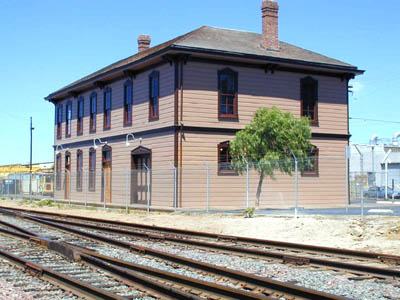
The San Diego Electric Railway Association has as its headquarters the historic 1882 California Southern Railway (ATSF) National City Depot.  They have been there like, forevar, so there is really no excuse for me not ever visiting. So what did I do? I finally paid them a visit.


They have quite of a collection of SDERy artifacts there. I was geeking out over an authentic SDERy conductors bell while mentioning the SDERy gong I saw on eBay when the docent  there said "I think we got that."  He proceeded to pull the gong out from behind an exibit. Sure enough, there it was!
Well I tell you one thing, I am so glad I didn't end up with it. Its huge! And weighs a ton! I would not have been able to display it as intended. I made my peace and gave the bell a ring (nice and loud!). I can not be any happier than to have it displayed at the museum where it truly belongs. So things worked out just fine after all.


Better yet, I didn't leave empty handed. I was able to  purchase another (and more reasonably sized) piece of SDERy artifactory. An authentic, well worn slice of SDERy girder rail (girder rail is rail used for tracks in paved streets). All is well with the world. I am satisfied. Yes sir! Satisfied!

Dandy

Saturday, December 09, 2006

Simulating Girder Rail.

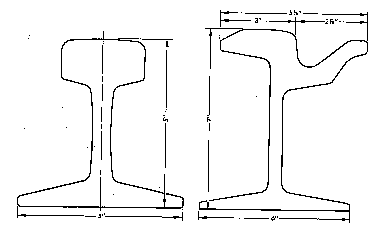
The prototype street railways use what’s known as girder rail to create the flangeway through the pavement. Here are cross section illustrations of standard “T” rail on the left, and girder rail on the right.

My plan is to simulate girder rail simply by laying two rails side-by-side to create the flangeways.