Read the Free Trolleyville Times Monthly for the Latest News on Prototype and Model Traction!
Showing posts with label weathering. Show all posts

Monday, November 07, 2022

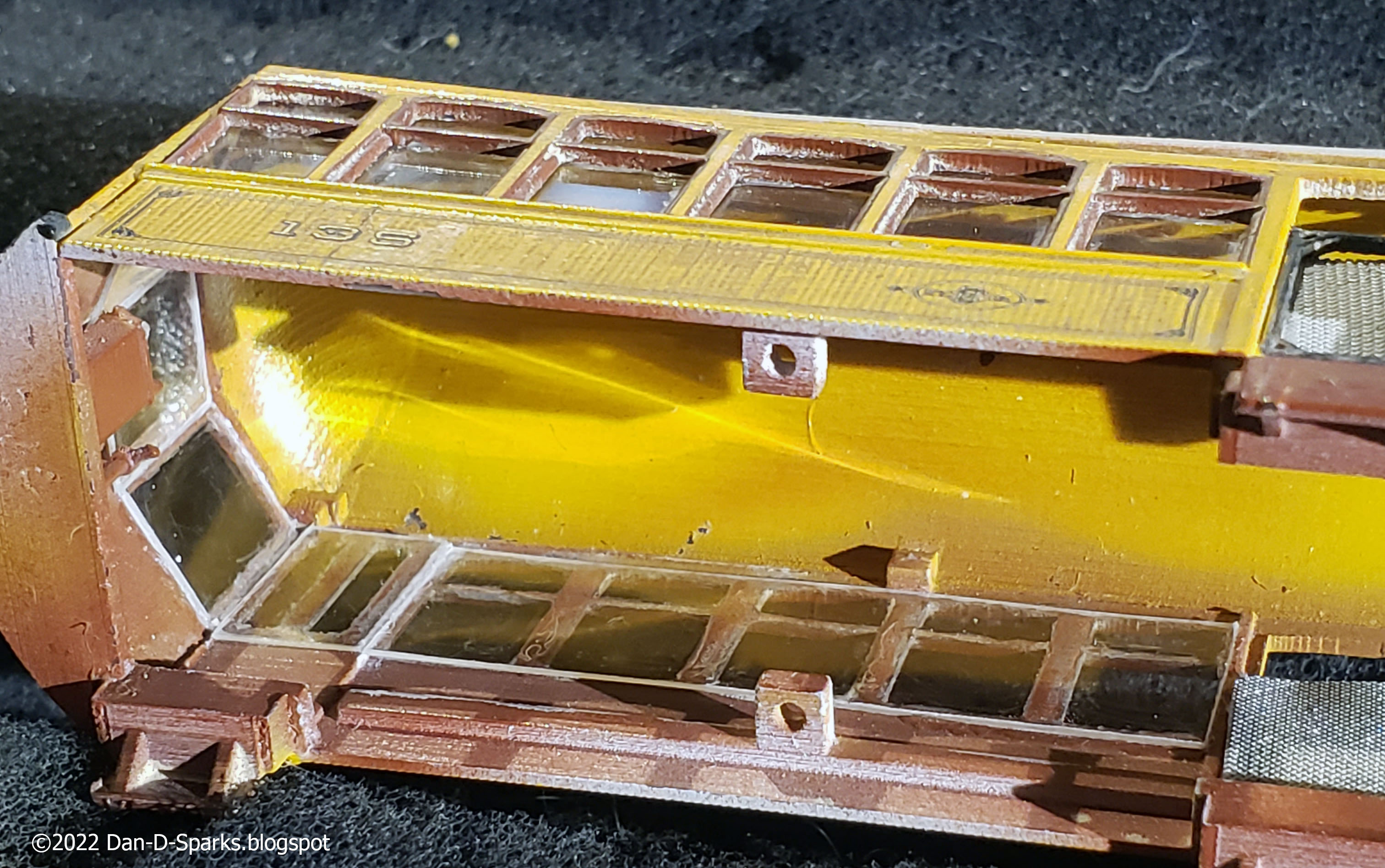
#135 ~ Glassed & Weathered

Adding Window Glass plus Dust and Grime.

An attempt has been made to make the car look like the daily conveyor of the public over the dry, dusty, unpaved streets of early 20th century San Diego.


The car was weathered with Bragdon Weathering Powders.  I managed to go a little more overboard with weathering than I intended to but, the car is looking like the hard working wooden cars it's meant to represent.  Also, the SDERy trolley company didn't seem to wash their cars much, so I'm not too far off.

After sealing the weathering with DullCote, the clear styrene was installed.  Individual panels for the end windows and the door, and a continuous piece for the side windows. The clear styrene was glued on with canopy glue.

Looking at historical photos of these cars I get the overall impression that they were pretty grimy. So I don't think that I'm that far off.

Yes sir!
I'm not that for off.

Dandy

Monday, March 24, 2014

Dirty Poles

Painting and Weathering Line Poles

I didn't get anything done on the layout this week :-( . So since I frequently come across photos I took but never shared, I thought I would share one with you.

 I take photos like these so I can remember how I did things. In this case the poles were painted with Floquil Light Green and weathered with Bragdon Rust and Weathering powders. So should I ever lengthen the boulevard and need to match to poles, well, here you go.

I was afraid I might have overdone the weathering on the poles, but recently I came across this picture of Broadway in San Diego and just look how dirty those line poles are!

 Looks like I nailed it after all! Yes sir! I nailed it after all!

Dandy

Monday, April 08, 2013

Tarnation Supply Warehouse

Building a Good Ol' Fashioned DPM Style Model for an Upcoming Project.

A bit of a diversion, how good does it feel to build one of these type of models again! Its been years for me!

The idea is to butt two of these "Schultz Garage" by Woodland Scenics models together to build a larger building...

Like this! They went together easily enough... except where the cement overflowed and dissolved some of the brickwork on the nearest corner. No worries! I'll think of something to hide that. The back of the facades don't have any detail, so since I have some left over wall material...

Sweet! This beefs up the wall and adds some more detail to the building.

I want a good old fashioned red brick color for the building. A lot of guys are using Americana craft acrylics for these sort of projects, so I thought I would give it a try. I went to my local Micheal's crafts store to get a bottle of "Americana Heritage Brick", but of course they were out, so I got the next closest thing, "Rookwood Red" with "Fawn" as the trim color. It doesn't really matter what color I get anyway, weathering will alter these colors dramatically.

See? Just adding a mortar mix already changed the color quite a bit. For the mortar I just rubbed on some Durhams water putty tinted to a light grey into the cast-in mortar joints. The building looks quiet stark this way, so its going to need to be toned down.

I gave the building a weathering wash which really toned things down and really brought out the detail (including the melted brick smudge on the near corner!). Most folks use an India Ink / Alcohol mixture for this, but I prefer a Bragdons Weathering Powders / Alcohol mix. It gives me a more dusty and dry look that I like for my Southern California set buildings.

For the windows and doors I used the same "Fawn" trim color.

And they were cemented into place. I'm thinking of doing something different for the freight door, so I skipped it for now.

There is a popular technique among craftsman where paper signs are sanded tissue thin so when applied to the side of a brick building they look painted on. So I thought I would give it a try. Its pretty tough to do and when my sign finally ripped, I stopped and glued them on. But I think it was too soon, they still look kind of thick.

I have some doors left over, so I thought I would experiment and see if I can make one look partially open...

I carefully cut out an opening and then filed it smooth up to the door frame.


The new freight door was painted and installed.

 Then the doors and windows received the same weathering powder / alcohol mix that the bricks did. Look how it really brings out the details. But now with that open door, I'll need some interior detailing.

With the last of the leftover wall material, I cemented them together to make an interior office space. I hate to waste, so this makes me happy.

So easy and effective.

The roof was constructed as per the instructions, but with longer pieces of styrene. But I'm not entirely happy with the plain roof, I mean, what kind of roofing material is that supposed to be anyway? So...

 A scale 3' strips of 600 grit sandpaper was cut and glued to the roof to simulate tar paper.


The "tar paper" was weathered with the Bragdon Weathering Powders.

Also of note is how thick the windows and doors are. The model comes with clear styrene to fit behind them, but I think it will just highlight that thickness. So...

 I've experimented with using Micro Kristal Kleer for windows in the past and wasn't too impressed, But for an industrial building like this, I think it might just be perfect! And it fits IN the window openings, not behind them. Its messy work, so it was applied from the back of the windows.

Micro Kristal Klear goes on white, but will dry clear. Being IN the window frames, this should help the window frames look thinner.

And there ya go! I'll come up with something to hide the melted brick thing when this building is put into its scene. But until then, this has been a fun little diversion. Yes sir! A fun little diversion indeed!

Dandy

Monday, December 06, 2010

Niles Project ~ Applying Decals to #107

Now that the decals are made, I'm going to try a different technique of applying the decals so as to help them settle more easily into the wood slats.


Remember, decals have to be applied onto glossy surfaces. Since I painted #107 with Floquil paints, which dry dead flat, a coat of gloss has to be sprayed on to where the decals are going to go. AND the decals need to be sealed as well. So while I have the gloss in the airbrush, I'll coat the decals with it as well.


Okay, Floquil Hi Gloss has been applied to the decals and #107. While they dry let me recap the decaling of #105...

With #105 the decals didn't want to settle into the deep wood slats. Eventually, the parts of the decal with air under it will dry out and flake off. So I'll probably loose that part of the "5", and the 3D drop shadow of the "0", and the rose buds on the corner flourish of the pin stripping, etc.  So after discussing the matter with Don Ball, it was concluded that it was difficult for the air to escape from under the vast expanse of the decal paper. So he suggested cutting the decals closer to the printing:


With a new, sharp eXacto blade, I cut out the negative areas of the decals that didn't contain any printing. But while applying the decals, I had a horrible problems with the decals curling! I wasn't able to get any photos since I was frantically trying to get the decals to lay down flat and straight before they set. Some decals got so distorted that I had to scrape them off and print new ones. Now its quite possible that this happened because the decal paper I used is over a year old. Fresh paper might behave better, but I don't know for sure. But I'll be sure to start with fresh decal paper next time since decal paper doesn't cost and arm or a leg.


Decaled and sealed with Dull Cote. Over all it looks good! But under closer inspection, the pinstripes are a bit wiggly, air bubbles can be seen here and there, and the edges of the decals are visible. Hopefully, some of these imperfections will be hidden by a bit of weathering. But over all, its looking good. Yes sir! Looking good!

Dandy

Sunday, October 10, 2010

Niles Project ~ Doing the Dirty Work

Weathering #105 to give it the appearance of a hard working interurban.

San Diego cars were a grimy lot. Look at this photo of #101. Its a dirty dirty trolley! The Wells Fargo panel looks to be recently painted (new express contract?), so its clean. but the sides and window posts are down right grungy. I suppose it would be difficult to keep a wooden car that makes its home working the hot, dusty dirt streets and in the moist salt air of a desert by the sea city clean. And judging by the automobiles, we're well into the teens if not the 20's by this time, so this car has many years of service under its belt rail.

Since my model of #105 has taken some modelers license to it, I intend to"go wild" with the weathering. This car will be the dirtiest of all my revenue cars, it will represent the dirty end of the weathering spectrum. The rest of the fleet will be a bit more classy in appearance. But for now, I'm going to have some fun with this.


There are some weathering techniques I want to try out. I'm a big fan of the Bragdon weathering powders, they are fantastic for, rusting, dusting, dirtying and "scale effect". I'll elaborate how to use the Bragdon Weathering System in a future post, but real quick, the powders contain a friction activated adhesive that affixes the powders when they are scrubbed on. But I want the powders to settle into the groves to accentuate the wood slats. So I'm trying the powders as a wash by mixing the powders with alcohol. The photo above is the result of this. I took a "0" brush load of the dark brown powder and mixed it with 4 drops of alcohol. The effect is stunning. Not only did the pigment settle into the groves, but it also stained the paint really nicely. It really desaturated to colors.

I thought I had overdone it. But comparing this photo with the prototype photo at the top of this post, it  actually looks about right. This car looks like a work-a-day interurban that has been making its rounds, keeping its schedule, and moving the merchandise. It has been a useful trolley, yes sir, a very useful trolley.

Dandy

Thursday, June 10, 2010

Niles Project ~ Primed and Ready

Getting ready for a nice coat of SDERy "Mission Yellow". Whatever color that is!
All right. With the Birney project once again wrapping up, I can now turn my attention back to the Niles cars. Here is where I'm at with that:

The new Sightseeing Car (far right) is awaiting its "De-PEing" while the other three have gotten a nice coat of primer. This time I'm using Floquil paint since I have come across a recipe for SDERy "Mission Yellow" utilizing that brand.

 On combine #105 though, I wanted to try out Floquil F110358 CSX New Image Gold. On paint swatches and in the bottle, it looks really close to being the right color for SDERy Mission Yellow. But on the car it looks very desaturated. And there is no way of saturating paint. You can desaturate paint by adding gray, but you just can't re-saturate a color. For the roof and under body details I'm trying out F110081 Earth. It looks good on the roof, even better when it gets weathered, but for the underbody details I might try Mud instead. The trim is painted in Roof Brown, but that's entirely too dark. I'm going to have to try mixing it with one of the Tuscan colors.
As you can see in this photo, SD&SE #101 has had a hard life. It started out as a passenger car, converted to an interurban, then involved in an accident and so rebuilt into a combine. I want to try to capture this flavor with my model of #105. So I just might leave it the faded color it is and just weather the heck out of it. Yes sir! Just weather the heck out of it!

~Dandy

Monday, May 25, 2009

Birney Project ~ Weathering

No matter how much I love the nice shiny, sparkling paint on this trolley, it's gotta be knocked down a notch. I need to have this trolley look like a hard working, earning a living, turning a buck, work a day trolley. And yet retain some of its cared for and maintained shine.

For this weathering project, I'm going to be using weathering powders. These are very fine powders that include a bonding agent that is activated from the friction of scrubbing on the powders.

The lightest colors seem to have the hardest time showing up where as the darkest colors are too easy to apply. So, as you can see, I start with the lightest color first. The light gray is perfect for making the paint appear faded (the left side of the car is weathered and the right side is untouched to illustrate the difference the powder makes). Next is the nice light tan for simulating dust, then dark tan for simulating dirt. And finally dark brown for grime. I'm mostly interested in the fading and dusting effects for simulating the hot and dusty desert-by-the-sea climate of San Diego.


I love the effect that the powders makes on my models, it makes them look so dusty and dry. The biggest difference the powders made are on the mahogany doors and windows. Note how you can see them now, the surface details being brought out, where as before the doors were so glossy and translucent that you really couldn't see them (compare to top photo).


Probably the best feature of weathering powders is how forgiving they are. If you don't like the results, simply wash it off. Or, you can tone it down dramatically with a coating of dullcote. I sprayed the car with a coat of gloss. That way the car is weathered and shiny. The gloss coat did away with about 95% of the weathering, but, 5% of the weathering remains. The car is very nicely lightly weathered and yet retains the shine of a new, cared for and maintained trolley car.
Then I went back in and did a little more light weathering with the powders. This time I won't affix them with anything, just letting the bonding agent in the powders do its thing. So now I have a slightly weathered trolley, but shiny too! Yessir! Weathered yet shiny too!

Monday, December 15, 2008

Birney Project ~ Painting and Detailing the Seats

Now that the seat assemblies for the Birney are built, it’s time to paint and detail them.

The trim color on SDERy equipment is brown, so I’m going to try out Scalecoat Roof Brown on the seats to see if it’s a good color for the trim.


Scalecoat is a high gloss paint, great for decals, not so much for seats. So I weathered the seats with some weathering chalk and then sprayed the seats with Testors Dullcoat to kill the shine. The seats on the left are freshly painted with Scalecoat, the seats on the right have been weathered and sprayed. After they have dried thoroughly, I can glue the figures in place.


I had to cut and file the feet off of the figures, not a natural thing to do! I also had to file some of the material off of their butts to get them to seat properly. None of this will been seen when the figures are riding in the trolley.


Once the figures are seated properly, I super glued them into place. The motorman I was able to leave fully intact since he sits higher and doesn’t have to deal with the mounting bar. Which is good because he is fully visible through the doors.


There! How’s that! Don’t quite notice the motor as much, hmmm? Yessir! Don’t quite notice the motor as much!

Dandy